Unverified listing
This gallery profile was created by Exhibo from public information. It is not managed by the organisation yet — details may be incomplete or outdated.
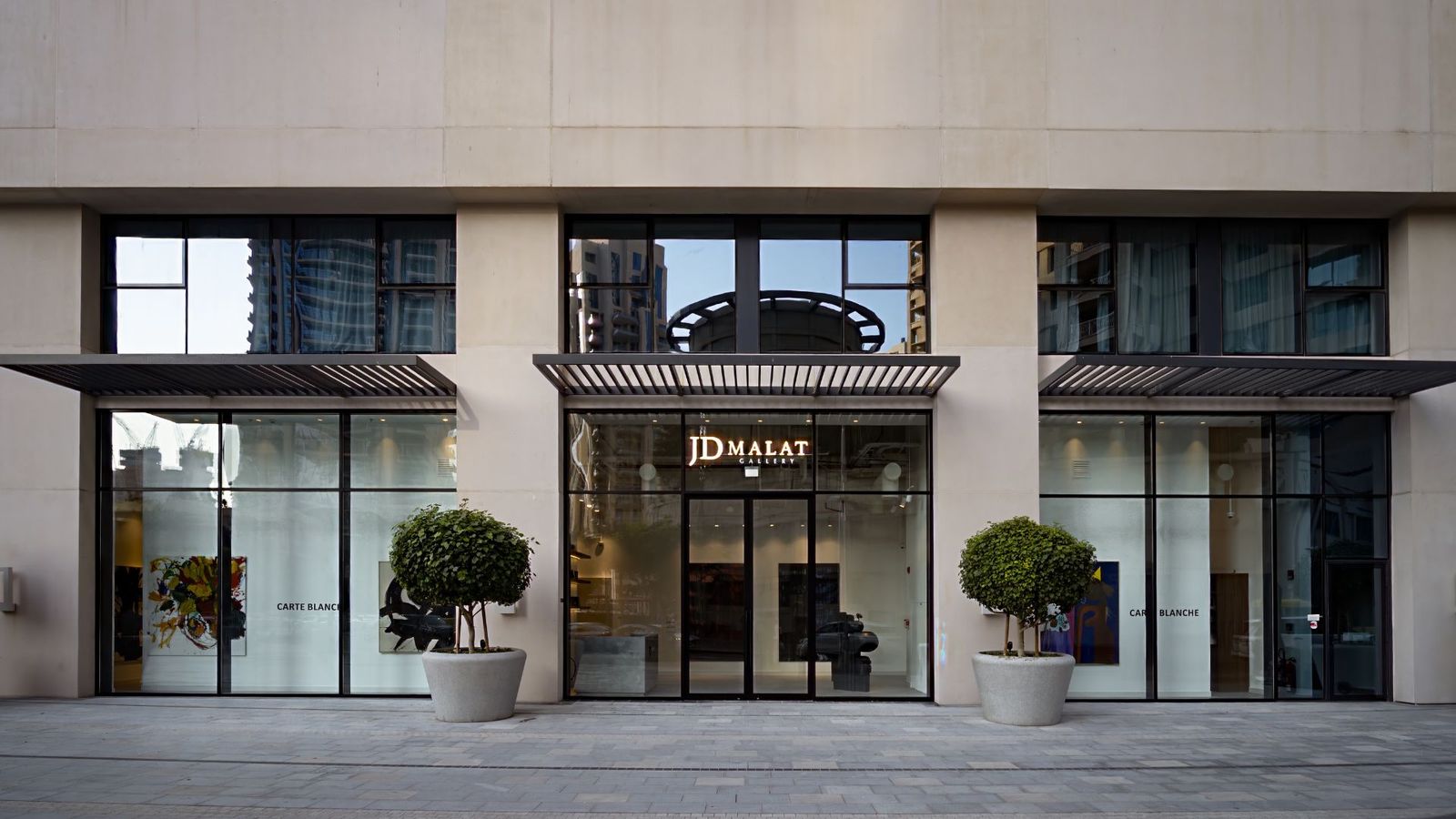

JD Malat Gallery
Artists, curatorial team, advisors, and partners connected to JD Malat Gallery.
Artists
Represented and guest artists exhibiting with the gallery.
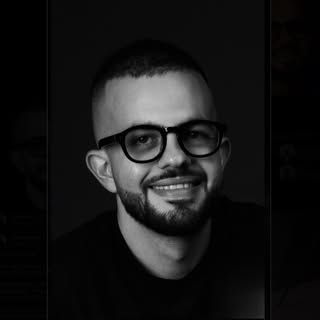
Foad Hamzeh
Foad Hamzeh grew up between Lebanon and Dubai. He studied architecture and art design at the American University of Dubai, then spent two years learning classical Arabic calligraphy with master calligrapher Wissam Shawkat — a training that gave him the grammar of the tradition before he started breaking it. His practice, developed under the name FH.Visual, sits at the point where calligraphy meets graffiti. He calls it calligraffiti. The letter is his primary material — not as carrier of meaning but as sculptural form. He developed his own Arabic typeface, FHV, for this purpose. The paint drips deliberately: language in motion, not yet settled. The work is three-dimensional, layered, built for specific spaces. Hotels, public buildings, the street. Hamzeh has spoken about wanting to reach people who weren't looking for art — which is perhaps why he keeps making it somewhere other than galleries.
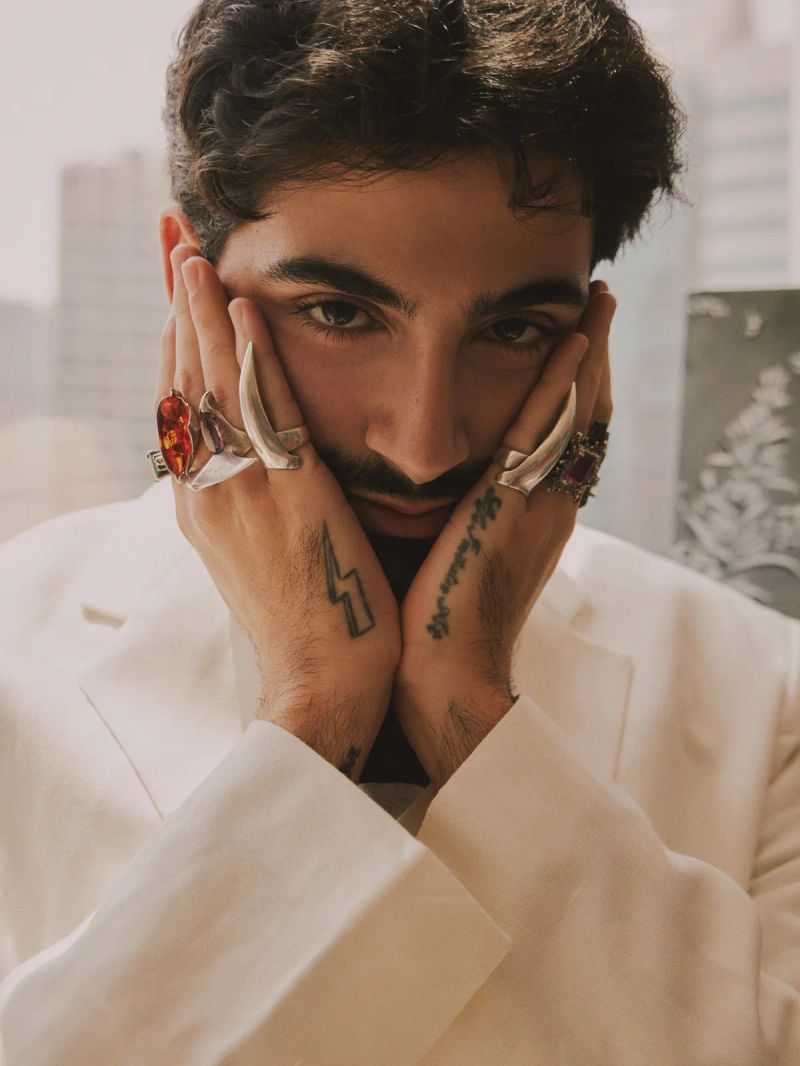
Samo Shalaby
Samo Shalaby grew up between Cairo and Dubai in a family of artists — his mother a painter, his aunt an artist, his sister running her own design practice. He absorbed the methods of making before he understood them. By the time he enrolled at Central Saint Martins in London, he'd already spent years in his mother's studio and several more doing commercial work he found creatively hollow. London changed something. "I didn't necessarily feel like I belonged anywhere before that," he has said. "Then I went to London — that's where it all unleashed." At CSM he studied stage design, costume and jewellery alongside fine art, and the theatrical logic stayed. His paintings feel like scenes from productions that don't exist yet: figures in ambiguous costume, worlds that seem historical but can't quite be placed, narratives that are simultaneously beautiful and uncomfortable. He draws from antiquity, surrealism and the grotesque, filtered through Egyptian and Palestinian heritage that runs through the work as undertone rather than statement. In one painting from 2024, he hid a battle scene, babies wrapped in keffiyehs, a woman holding a blue and white mask — symbols embedded in a composition rich enough that most viewers don't find them immediately. That's deliberate. "I wanted the symbolism to be more of an undertone, for people to find it." He has shown at Abu Dhabi Art, Kiaf Seoul, Soho Revue London, Marignana Arte Venice, and Lee & Bae Gallery Busan. He lives between Dubai and London.
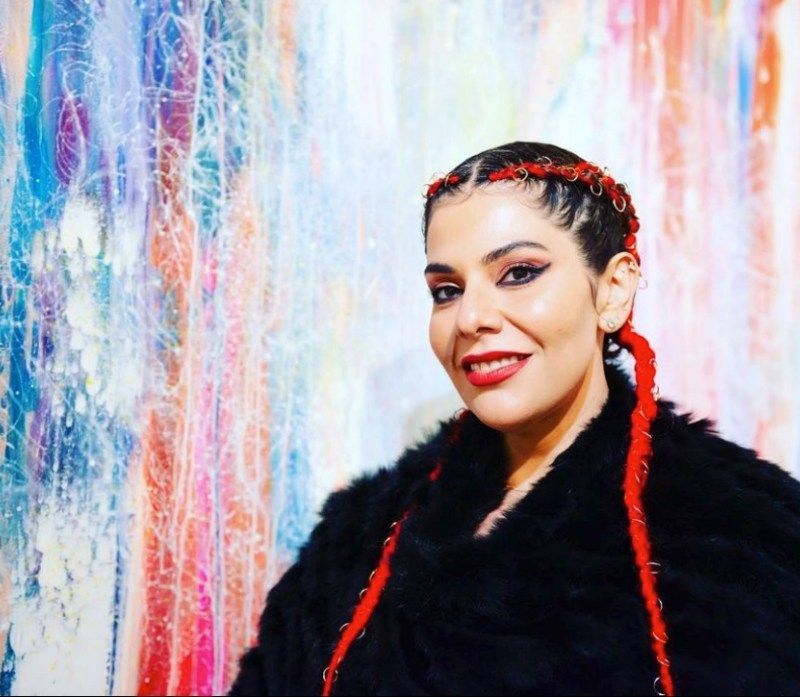
Camelia Mohebi
Camelia Mohebi grew up between three countries and three languages — Dubai, Tehran and Geneva — before studying visual communication in London. The trajectory of her practice maps neatly onto that biography: a restlessness between disciplines, a refusal to stay in one register, and a persistent return to the same question, which is something between what does healing look like and what does it feel like to be seen. She started painting professionally after 2002, while simultaneously building a children's brand with three stores across the UAE. In 2015, when her father was ill, something shifted. She turned toward healing modalities — Neuro Linguistic Programming, Theta Healing, quantum healing — not as alternatives to art but as extensions of it. Sound frequencies, sacred geometry, the subconscious mind: these became materials in the same way that acrylic paint and stainless steel are materials. Her work since has been about making that interior landscape visible. The result is a practice that is genuinely hard to categorise, which is probably the point. She paints on canvas, leather, velvet, wood and musical drums. She works digitally and then prints and paints over the print. She embeds strings into canvases to mark the meeting points of symmetrical compositions inspired by esoteric cosmology. She uses Swarovski crystals to refract light across surfaces. She has described one series as based on the philosophy of seven planes of existence — the sixth plane, specifically, "where all inspiration and mathematics and sacred geometry lies." Mohebi first received national recognition in 2009 through Emirati Expressions in Abu Dhabi, one of the first major showcases of contemporary UAE art. Her solo exhibition Signals at Sotheby's Dubai in 2022 brought her to an international collector audience. A triptych from her Diffusion series is in the permanent collection of the Barjeel Art Foundation in Sharjah. In 2023 she founded The Sima Collective, a platform supporting emerging artists through residencies, workshops and exhibitions. She has shown in New York, London, Milan, Hong Kong and across the UAE.
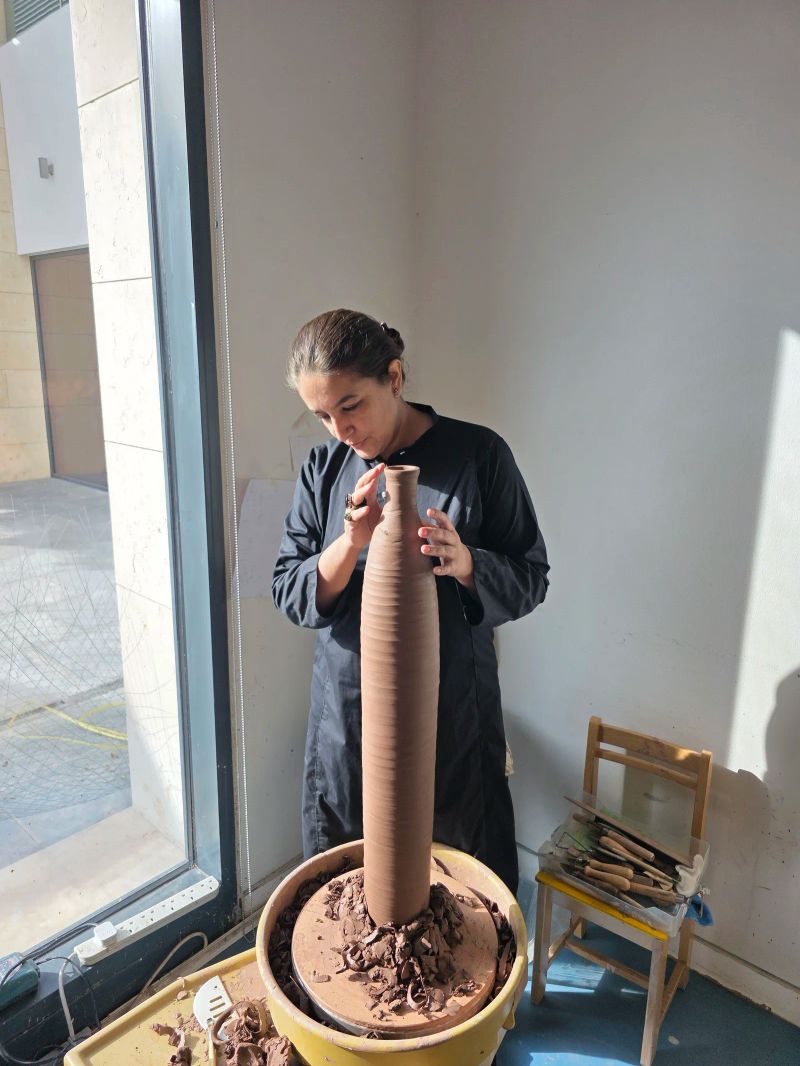
Anila Ashraf
Anila Ashraf started working with clay in 2020. That's a surprisingly recent beginning for someone whose practice already has the confidence of a much longer career — but it explains something about how she works. There was no gradual accumulation of academic training and studio habit. She came to ceramics directly, through wheel throwing, and the wheel has stayed central to everything she makes. Her studio practice operates under the name LaTakhaf Ceramics. La takhaf means "do not fear" in Arabic — a phrase that functions as both a personal manifesto and a curatorial logic. She works with traditional wheel-thrown forms and then alters them: cutting, collapsing, reassembling, adding specialised glazes and tactile surfaces that push the vessel away from function and toward sculpture. The result sits in the unresolved space between the two, which is where she wants it. At Dubai Design Week, her work was described as "big, bold and eccentric pieces touched with the vibrant hues of various glazes" — work that holds "a juxtapose of valor and serenity," a paradox that is also a pretty good description of the wheel-throwing process itself, where control and surrender happen simultaneously. Central to the practice is an acceptance of imperfection as a structural element rather than a failure to be corrected. Clay fired in a kiln does not always do what you expect it to do. Ashraf has built a philosophy around that — around what transformation looks like when you stop trying to prevent it.
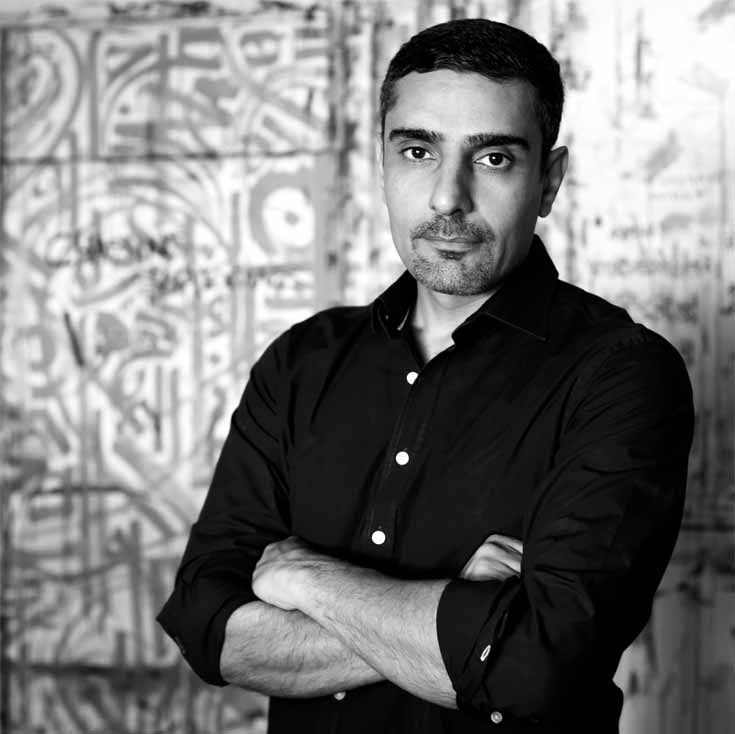
Sasan Nasernia
Sasan Nasernia grew up in Tehran surrounded by calligraphy — not as decorative tradition but as living language, as a practice that held together script, image and meaning in a way that Western typography never quite managed. He trained at Azad Art University, earned his BFA, and started his career as a calligrapher and typographic designer. Then he started taking the rules apart. The result is what he calls "Crazy Kufic" — a term that sounds playful but describes something more serious. Kufic is the oldest form of Arabic calligraphy, angular and architectural, designed for stone inscription rather than flowing manuscript. Nasernia goes back to that origin and then destabilises it: letterforms stretched, collapsed, dripped, interlocked, stripped of their semantic content until they stop communicating language and start doing something else entirely. What they start doing is closer to physics than literature. He has described his practice as seeing the world as "a gigantic code where the spoken and written word has a primal influence" — influenced by philosophical notions of chaos versus cosmos, by modern physics, by impermanence as a structural principle rather than a subject. The works borrow from Persian miniature painting and historical iconography while operating in the register of contemporary abstraction. In one mode, text becomes image. In another, the image returns to something that almost reads as text but doesn't quite. The viewer is caught between interpretation and sensation, between the learned response to seeing script and the unfamiliar experience of script that refuses to be read. He has shown at the Sharjah Calligraphy Biennale, the Larnaca Biennale, Mestaria Gallery at Alserkal Avenue, and Kalimat Gallery Dubai. In 2025, he was selected from over 300 submissions for Made in the UAE at JD Malat Gallery. He lives between Dubai and Vancouver.
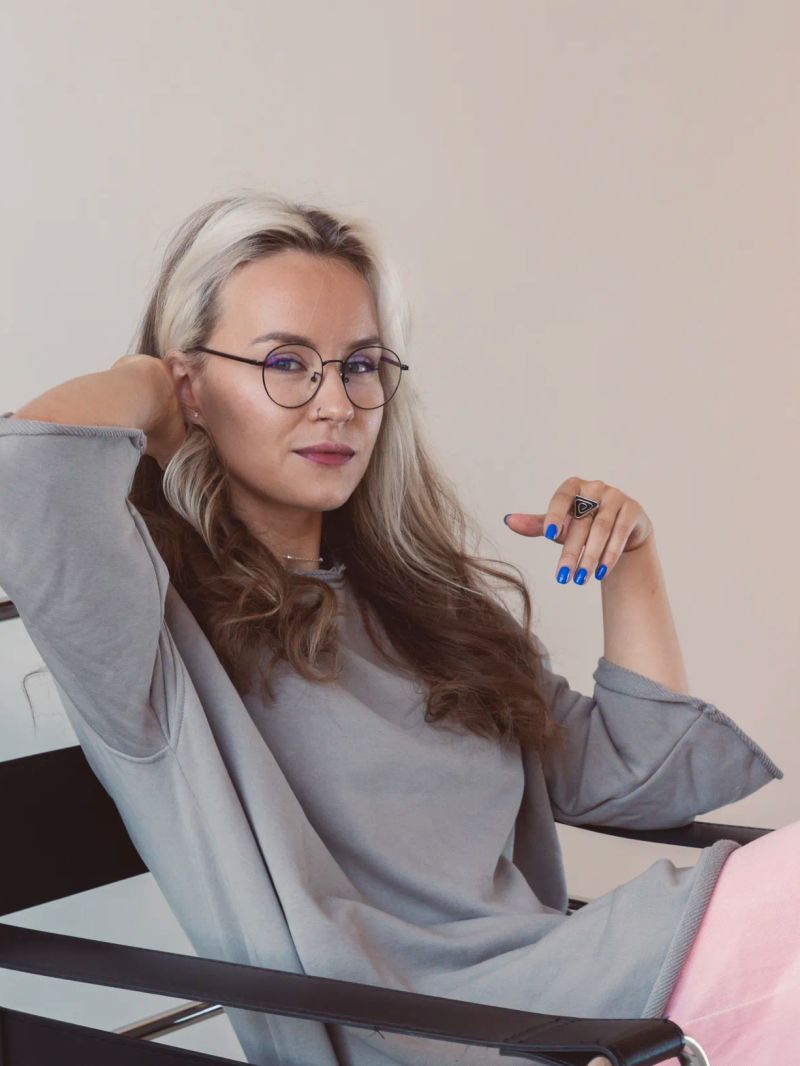
Elizaveta Pugacheva
Elizaveta Pugacheva grew up in Russia drawing since childhood, spent years making landscapes to order, and then in 2020 — during lockdown, in a workshop with fewer commissions than usual — something happened. She couldn't sleep. An image appeared: an abstract landscape. She spent the next day trying to make it. "I was completely taken by the process," she has written, "the thick acrylic paint flowing down, choosing its own direction, where I become just an observer. There were no rules, no expectations." That night became the turning point she describes in every account of her practice. The shift from commissioned work to what she calls "conceptual realism" — work that challenges the viewer's perception of ordinary things. She relocated to Dubai in late 2023, and the city entered the work: questions of migration, adaptation, cultural displacement, the way identity shifts when home becomes something you reconstruct rather than inherit. Her own words from Artsy: "I incorporate ornaments, prints, memorabilia fabrics, clothing, and forms taken from my childhood film photographs, as well as references from my grandmother's house in a Siberian village." The palette is recognisably hers: blue dominates — cornflower blue specifically, which she describes as "one of the most enchanting and relaxing colors for the human eye" — in tension with warm oranges that "embody novelty, brightness and sometimes anxiety of change." She works across painting, graphic art and textile panels, combining acrylic, oil, oil pastel and appliqués on linen canvas. The first layer is always acrylic paint flowing freely. After that, she decides what to do with what arrived. She has shown at World Art Dubai, Art Russia Fair, Art Ankara and in galleries across Saint Petersburg and Moscow. Made in the UAE at JD Malat Gallery in 2026 is her first international gallery exhibition.
Partners
Institutional partners, collaborators, and allied organisations.